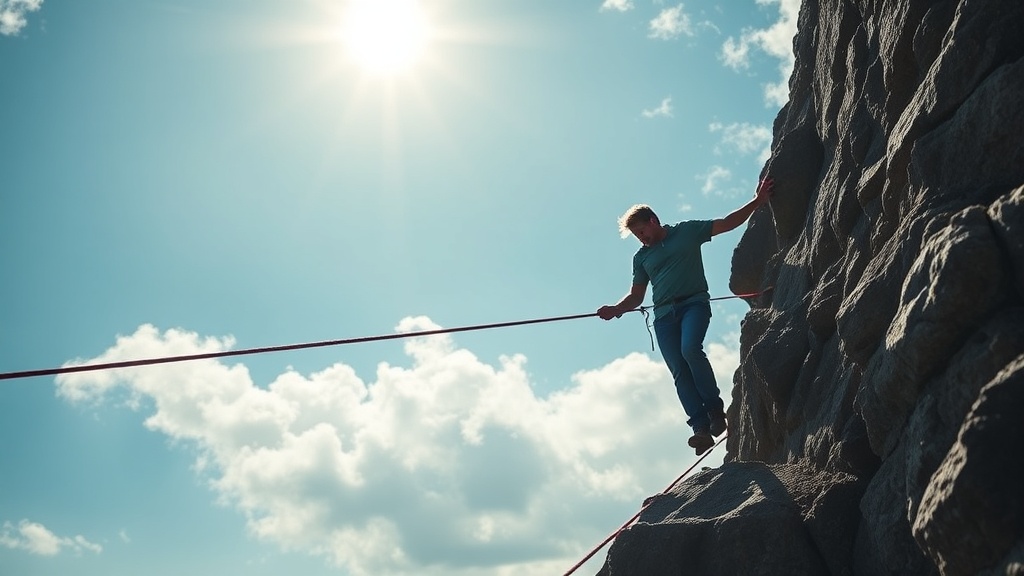
Where to Look on a Slackline So Your First Walks Stop Falling Apart

This guide will show you where to aim your eyes during slackline practice, how to pick a target before you mount the webbing, and why that choice changes the quality of your first walks. Most beginners hear one cue over and over: look forward. That's fine as a starting point, but it's too vague to help once the slackline starts snapping side to side. A better answer is to give your eyes one job at a time. When your target is clear, your head stays quieter, your arms stop making last-second panic swings, and your corrections on the webbing get smaller instead of louder.
What should you look at while walking a slackline?
You should usually look at a still target beyond the line, not at your feet and not at the moving webbing itself. Pick something that doesn't drift: the far anchor, a knot in the bark behind it, a bolt on a post, a mark on a wall, or even a crack in the pavement past the line. The exact object matters less than its stability. If the target moves in your vision, your body tends to chase that motion.
That's the part most new slackliners miss. They aren't just balancing on a narrow surface; they're trying to balance while watching a surface that never stops moving. If your eyes lock onto the line, your brain has to sort out whether the motion came from the webbing, your body, or both. That delay is tiny, but on a slackline tiny delays turn into big corrections.
A fixed target on a slackline gives your nervous system a cleaner reference. Research on visual fixation and postural sway has shown that stable targets can reduce sway in standing tasks. Slacklining is more dynamic than quiet standing, of course, but the coaching lesson still holds: a calm point in your visual field makes it easier to notice what your body is doing without the extra noise from the line's motion.
Why do slackliners lose balance when they stare at their feet?
Looking down isn't a moral failure. It's a reflex. When you feel unstable, you want more information, and your feet seem like the place to get it. The problem is that looking down changes your whole stack at once. Your chin drops, your upper back rounds, your chest closes a bit, and your weight tends to shift ahead of your midline. On the ground you can get away with that. On a slackline it usually speeds up the wobble.
There's another issue: when your eyes jump between your foot, the webbing, and the anchor, your attention fragments. Instead of letting balance corrections happen rhythmically, you reset your reference point every second or two. That's why a lot of beginners feel fine for one step, then suddenly lose the line after the second. They don't actually lose balance first. They lose visual consistency first, and the body follows.
If you want the blunt version, here it is: staring at your feet teaches you to react late. Your feet tell you where the problem already is. A point ahead of you helps you organize the correction before the wobble grows. That's also consistent with the broader role of vision inside the balance system described by MedlinePlus, which notes that balance depends on the combined work of visual, inner-ear, and body-position signals.
How far ahead should your eyes focus on the line?
The sweet spot depends on line length, tension, and what you're practicing, but most people do best when their gaze lands somewhere near the far third of the line or just beyond the far anchor. Too close, and you get sucked into the line's motion. Too far, and you may lose the useful directional cue the line gives you. You want enough distance to quiet the visual scene while still feeling connected to where you're going.
| Situation | Best target | Why it works |
|---|---|---|
| First sessions on a short line | Far anchor or tree trunk behind it | Large, easy target that stays still |
| Walking a medium backyard line | A point just beyond the far third | Keeps your posture up without overreaching visually |
| Longer or looser lines | Alternate between horizon-level target and anchor zone | Gives stability while letting you read line direction |
Here's my rule of thumb: if you feel cross-eyed or frozen, your target is probably too small or too far away. If your head keeps bobbing and your eyes keep dropping, your target is probably too close. Make the change obvious. Pick a bigger object. Give it a name in your head. Commit to it for a full attempt instead of changing targets mid-wobble.
There is good evidence that gaze and body sway interact tightly during balance tasks; this open-access study on gaze and postural sway is a useful reminder that the eyes don't just observe balance, they shape it. On a slackline, that means your gaze is part of your technique, not a passive detail.
What is a simple slackline gaze drill before your first walks?
Do this for 10 minutes before you start chasing long walks. It works because it strips the skill down to one variable at a time. You're not trying to look impressive. You're trying to make your slackline gaze behavior boring — and boring is good when the line is lively.
- Choose one target. Stand at the start of the line and pick a still point beyond the far anchor. Don't change it for the rest of the drill.
- Mount and freeze for three breaths. Step onto the line, bring your eyes to the target, and stay there for three slow breaths. If you fall, remount and use the same target again.
- Take one deliberate step. Keep your eyes on the target through the whole step. If your foot lands badly, resist the urge to glance down right away.
- Reset with your exhale. When the line shakes, breathe out and soften your face and jaw. People often tense their eyes when they're scared, which spreads tension into the neck and shoulders.
- Add two to three steps only when the gaze stays steady. Don't progress because you got lucky once. Progress when your visual target stays consistent across several attempts.
This drill sounds simple because it is simple. That's why it works. You don't need a new trick every session. You need repeated exposure to the same clear cue until your body starts trusting it. After a week of practice, many people notice that their arms quiet down before their feet improve. That's normal. The gaze cue usually cleans up upper-body noise first.
Can you glance down during a slackline mount?
Yes — just don't live there. A quick glance can help during a mount, when checking foot placement for static tricks, or when the line setup is unfamiliar and you need one clean look before committing weight. The mistake is turning that glance into a staring habit. A glance gathers information. A stare drags your posture out of shape.
A good pattern is this: look down briefly before the mount if you need to, place the foot, then bring your eyes back to the target before loading the line fully. Once you're standing, keep returning to the still point ahead. If you fall after looking forward, that doesn't mean the cue failed. It usually means your body hasn't learned to trust the cue under stress yet.
Be honest about what kind of wobble you have. If it's a frantic side-to-side shake, your gaze is probably darting and your head is moving with it. If it's a slow forward collapse, you're likely dropping your chest and eyes together. Different wobble patterns point to different fixes, but both respond well to a more stable slackline gaze routine.
What mistakes keep this slackline cue from working?
The first mistake is changing targets on every attempt. Pick one and stick with it long enough to learn from it. The second is choosing a target that isn't actually stable — leaves, people, passing cars, even a shadow line can pull your attention around. The third is trying to stare with your eyeballs while the rest of your head is whipping around. Your gaze cue works best when your head, neck, and breath stay relatively soft.
The fourth mistake is expecting instant magic. Better visual focus won't turn a badly set line into a friendly one, and it won't replace time on the webbing. It does make practice cleaner. It gives you a reliable reference when nerves rise, and it stops your eyes from adding chaos to a skill that already has enough of it.
Next slackline session, pick a target before your first mount and refuse to negotiate with yourself about it. Give that one point five clean attempts. Keep your jaw loose, let the webbing move under you, and make your eyes do less. That's often the fastest way to make your whole body do better on the line.