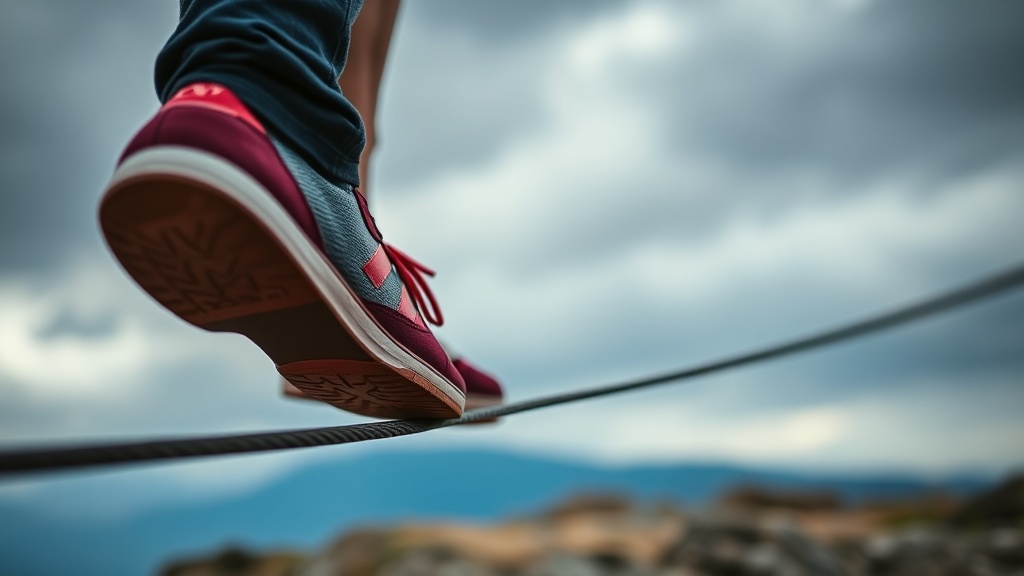
What Foot and Ankle Conditioning Means for Your Slackline Sessions

This post covers targeted foot and ankle conditioning exercises that translate directly to better slackline performance. You'll learn specific drills to strengthen intrinsic foot muscles, improve ankle mobility, and build the proprioceptive awareness that keeps you stable on the line—whether you're working on your first walk across or dialing in highline maneuvers.
Why Do My Feet Burn Out So Quickly on the Slackline?
If you've ever stepped off a slackline with your feet screaming and calves trembling, you're experiencing what seasoned line walkers call "foot pump." It's not just about endurance—it's a sign that the small muscles in your feet are working overtime because they haven't been conditioned for the unique demands of slacklining.
Unlike walking on solid ground, where your foot acts as a relatively stable platform, slacklining requires constant micro-adjustments. Your foot becomes an active balancing instrument, not just a passive weight-bearing structure. The intrinsic muscles—the tiny stabilizers between your metatarsals and within your arches—fire repeatedly to keep you upright. When these muscles are underdeveloped, they fatigue fast, sending compensatory signals to your calves and hips that throw off your entire chain of balance.
The fix isn't just more time on the line. Off-line conditioning builds the foundational strength and neuromuscular control that make your sessions last longer and feel more controlled. Think of it as preparing your hardware before you upgrade your software.
What Exercises Build Slackline-Specific Foot Strength?
Here are four drills that directly target the muscle groups and movement patterns you'll use on the slackline:
1. Short Foot Activation (The Foundation)
This exercise wakes up your intrinsic foot muscles without loading them. Sit in a chair, feet flat on the floor. Without curling your toes or lifting your heel, try to "shorten" your foot by drawing the ball of your foot toward your heel. You should see your arch lift slightly. Hold for 10 seconds, release, repeat 10 times per foot.
The short foot position mimics the active arch engagement you need when standing on a slackline. Most people can't hold it for more than a few seconds initially—that's normal. Practice until you can maintain the contraction for 30 seconds without compensating.
2. Single-Leg Balance on Unstable Surfaces
Once you can activate your short foot, add balance challenges. Stand on a foam pad, pillow, or folded towel—anything that compresses under your weight. Lift one foot and hold for 30-60 seconds. The key is maintaining that short foot position throughout; don't let your arch collapse as the surface shifts.
This builds the same proprioceptive pathways you'll use on the slackline, but with reduced consequences when you lose balance. Your ankle learns to make those constant micro-corrections without the fear of falling.
3. Eccentric Calf Raises
Rise onto both toes, then lift one foot and slowly lower yourself down on a single leg over a count of three. Do 3 sets of 10-15 reps per side. The controlled lowering phase strengthens your calf muscles' ability to absorb force—which translates directly to softer landings and more controlled bounces on the line.
Strong calves aren't just about pushing off; they're about controlling how your foot meets the surface. On a slackline, that control keeps the webbing from oscillating beneath you.
4. Toe Yoga (Yes, Really)
Lift just your big toe while keeping the other four pressed down. Then reverse—press the big toe down and lift the other four. Alternate for 2-3 minutes per foot. This builds independent toe control that helps you grip and adjust on the line without over-gripping (which sends unnecessary tension up your legs).
Most people's toes move as a unit—like mittens instead of gloves. Slacklining benefits from glove-like control.
How Does Ankle Mobility Affect Slackline Performance?
You've probably seen slackliners with locked knees and rigid ankles, looking like they're walking on stilts. That's inefficient—and exhausting. Adequate ankle mobility lets you stay loose, absorb movement from the line, and make fluid corrections.
Tight ankles force compensations upstream. When your ankle can't dorsiflex enough, your knee bends more or your hip hikes. When your ankle can't invert or evert through its full range, you lose degrees of freedom for balance recovery. The result is a stiff, high-energy style that tires you out fast.
Here are two mobility drills to open up your ankles for slacklining:
Ankle CARs (Controlled Articular Rotations): Stand on one leg, lift the other foot slightly off the ground, and slowly rotate your ankle through its full range—biggest circle you can make without compensating at the knee or hip. 10 rotations each direction, each foot. This maintains the joint's access to all its movement options, which matters when the line shifts unexpectedly.
Knee-to-Wall Dorsiflexion Test and Drill: Face a wall, place your toes 4-5 inches away, and try to touch your knee to the wall without your heel lifting. If you can't, that's a range of motion deficit worth addressing. Work the position—hold the knee near the wall for 30 seconds, oscillate gently in and out of end range, repeat. Better dorsiflexion means better shock absorption and more balanced weight distribution.
Can Better Foot Conditioning Reduce Injury Risk?
Absolutely. Most slacklining injuries aren't dramatic falls—they're overuse problems that develop when feet and ankles aren't prepared for repetitive loading on an unstable surface. Plantar fasciitis, Achilles tendinopathy, and ankle sprains often trace back to inadequate preparation.
Strong, mobile feet distribute force more evenly. They don't collapse into valgus (rolling inward) or rely solely on the big toe for stability. When your foot functions well, the slackline's forces travel through your structure instead of getting trapped in vulnerable tissues.
Athletes in other balance-heavy sports have known this for years. Gymnasts, dancers, and figure skaters all prioritize foot and ankle conditioning—not as an afterthought, but as a core part of training. Slacklining benefits from the same approach. For more on how foot function connects to whole-body performance, the American Orthopaedic Society for Sports Medicine offers detailed guidance on foot and ankle conditioning for athletes.
Start your conditioning 10-15 minutes before you step on the line. Use the short foot activation and a few ankle CARs as part of your warmup. You'll notice the difference immediately—more control, less wobble, longer sessions before fatigue sets in.
The research on barefoot training and intrinsic foot muscle activation continues to grow. A 2019 study in the Journal of Foot and Ankle Research found that targeted foot strengthening improved balance performance in healthy adults—a finding that directly applies to slackline practice.
Consistency beats intensity here. Five minutes of foot work daily will outperform an hour once a week. Your feet adapt slowly but thoroughly. Give them the regular stimulus they need, and they'll reward you with sessions that feel grounded instead of frantic.
Integrating Foot Work into Your Training Week
Here's a simple framework: On non-slackline days, do 15-20 minutes of focused foot and ankle conditioning—short foot holds, balance work, calf raises, and mobility. On slackline days, use the activation drills (short foot, ankle CARs) as your warmup, then train on the line, then finish with mobility work while your tissues are warm.
This approach builds capacity during rest days and expresses that capacity during line sessions. Over weeks, you'll notice your feet stop being the limiting factor. Your mind can focus on technique, line reading, and committing to moves—instead of managing burning arches and trembling calves.
For a deeper dive into proprioceptive training methods used by elite balance athletes, the National Strength and Conditioning Association has excellent resources on proprioceptive training protocols.
Your slackline skills will always be limited by your weakest link. For most people, that link is below the knee. Address it directly, and everything above it works better.