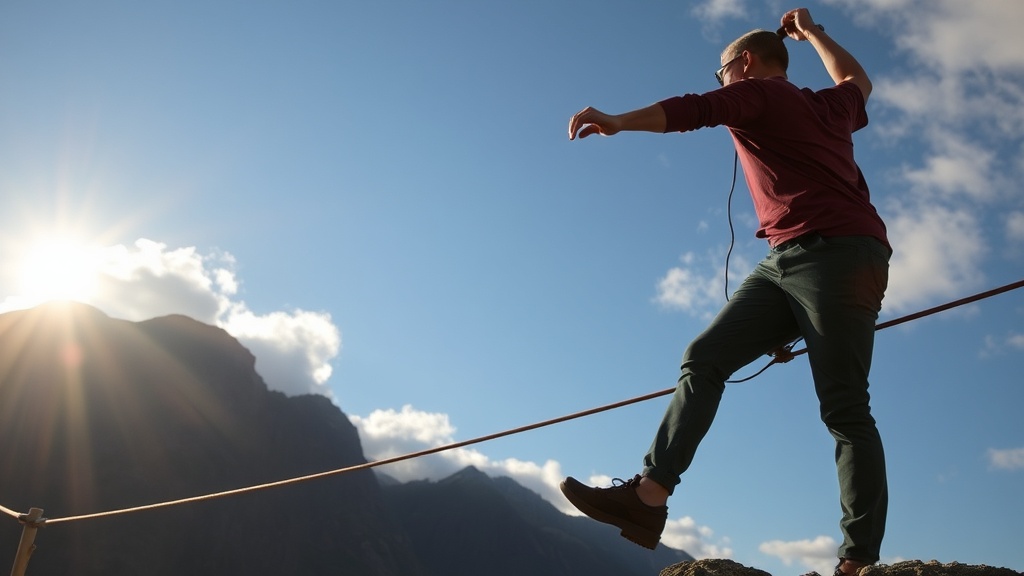
The Exhale Cue That Calms a Shaky Slackline Walk

Quick Tip
When the line starts shaking, keep the inhale small and let one longer exhale carry the next step.
You're six steps into a clean walk, the line starts buzzing, and suddenly your shoulders climb, your jaw tightens, and the whole thing feels twice as fast. Most beginners think the problem is in their feet. A lot of the time, it starts higher up: they stop breathing. This covers the simple exhale cue that settles the body when a slackline gets noisy, why it works, and how to practice it without turning every session into a breath-counting project.
Why do I hold my breath on a slackline without noticing?
Because your body reads a wobble like a threat. The instant the line twitches under you, it tries to create stiffness. That sounds helpful, but on a slackline stiffness often becomes extra motion. Your ribs lift, the neck gets busy, and the small corrections you need turn into big corrections you can't hide. It feels like you're trying harder. In reality, you're bracing.
That bracing shows up in familiar ways: locked knees, toes clawing the webbing, hands snapping around like windshield wipers, and a stare so hard that your face gets tired before your legs do. If this sounds familiar, don't treat breathing as some soft add-on. It's part of balance control. A recent systematic review indexed on PubMed looked at how acute respiratory demand can affect postural control, which lines up with what slackliners feel in real sessions: when breathing gets strained, balance gets messier.
There's also a simple mechanical piece. When you hold your breath, your trunk tends to stiffen as one block. On a stable floor, you can get away with that for a while. On a moving line, you need the rib cage, pelvis, and shoulders to make tiny adjustments without turning the whole body into a statue. A quiet breath keeps those adjustments available.
If you've ever stepped off the line and noticed yourself taking one huge gasp right after the fall, that's your clue. The breath was missing before the jump-off, not after it.
What breathing pattern actually helps when the line starts shaking?
Keep it simple: small inhale, longer exhale. Not because there's magic in a certain count, but because a long exhale tends to lower the sense of urgency in the body. You don't need to sound like you're in a yoga class. You just need enough air moving that your shoulders stop trying to do the diaphragm's job.
A good starting rhythm looks like this: inhale lightly as you prepare the next step, then exhale as the foot lands and the line answers back. If the wobble spikes, keep the exhale going a beat longer rather than sucking in another quick breath. That one choice often stops the second mistake, which is piling tension on top of tension.
In through the nose while you set up. Long breath out when the line talks back.
If you want a general refresher on belly breathing, the Cleveland Clinic's diaphragmatic breathing overview is clear and practical. The American Lung Association also explains why a longer exhale and relaxed shoulders tend to make breathing feel easier. Those pages aren't written for slackliners, but the carryover is obvious on the line.
| Moment on the line | Common reaction | Better cue |
|---|---|---|
| Before stepping up | Big chest breath | Low, quiet inhale |
| Foot touches down | Freeze and brace | Exhale through the landing |
| Line snaps side to side | Rapid breaths | One slow breath out |
| Near a fall | Hold breath and jump late | Exhale, then step off on purpose |
The count matters less than the feeling. If a four-count inhale and six-count exhale helps, fine. If counting makes you rigid, drop it. The real target is this: can you keep air moving while the line is moving? That's the skill.
One more thing: don't wait until the line is in full chaos to breathe. Start before the problem. A calm breath is much easier to keep than a panicked breath is to fix.
Should you breathe through your nose or your mouth while slacklining?
Most of the time, inhale through the nose if you can. It helps keep the breath smaller and less dramatic. A giant open-mouth inhale usually pulls your chest up and invites the exact tension you're trying to avoid. On warm-up walks and easy drills, nose in and relaxed mouth out works well for most people.
But don't turn this into a purity test. If the line gets spicy and you need to exhale through pursed lips or take air through the mouth for a second, do it. The goal isn't to look composed. The goal is to stop the chain reaction that leads from wobble to brace to bailout.
A lot of athletes get stuck because they add another rule: only nasal breathing, only perfect posture, only soft hands, only silent feet. That's too much to manage while you're learning. Give yourself one rule instead: never let the breath disappear. If it changes shape for a moment, that's fine.
Think of breathing on the slackline the same way you'd think about hand position. There's a preferred pattern, and then there's what keeps the rep alive. You can clean it up later.
How do you train this cue before your next full walk?
Don't start by trying to breathe perfectly across a long line. That's too much task at once, and it usually turns the drill into a frustration contest. Build it in layers so the breath cue survives contact with movement.
- Stand on the line with one hand on your anchor or a training stick. Take one light inhale, then let a slow exhale run while you stay tall for three to five seconds. Step down before you need to scramble.
- Practice two-step reps. Step up, take one step, then another, and let each foot contact happen during the exhale. Reset. You're teaching timing, not grinding for distance.
- Use the step-off as part of the drill. When the wobble gets ahead of you, breathe out and step off on purpose. That teaches your body not to pair every mistake with a breath hold.
- Shorten the line or lower the tension for practice sets. The goal is to feel the cue often, not prove toughness.
Off the line, you can make this even easier. Stand on a curb, a folded towel, or any mildly unstable surface. Shift your weight from one foot to the other and match each shift with a quiet exhale. It's not identical to slacklining, but it builds the habit of letting balance corrections happen while you keep breathing.
If you're coaching yourself, use a spoken cue. Quietly say 'out' or 'ssss' as the foot settles. The sound keeps you honest. Silent intentions are easy to fake; audible breath isn't.
This is also one of the few drills that's worth doing when you're tired. Not exhausted, but tired enough that your old habits want to reappear. That's where the cue becomes real. On your freshest attempts, almost any pattern feels smart. Late in the session, the useful one is the one you can still keep.
Why does breathing change what your feet and shoulders do?
Because the feet and shoulders aren't acting alone. When the breath gets stuck, your whole system tends to solve the problem with grip. The toes grip. The glutes grip. The hands swing harder. The neck grips so much that your gaze turns glassy. None of that is random. It's one full-body response.
A steady exhale interrupts that response early. Your shoulders drop a notch, the hands stop trying to win the rep by force, and the feet can feel the webbing instead of attacking it. That doesn't make the line easy; it makes your corrections smaller and faster. On a slackline, smaller and faster usually beats stronger and later.
This is why some beginners improve the second they stop trying to pin the line still. Balance on a slackline isn't about removing all motion. It's about staying organized inside motion. Breathing helps organize the body without making it slow.
- If your shoulders are burning first: your inhale is probably too big.
- If your feet cramp quickly: you may be bracing through every wobble instead of letting one breath carry the correction.
- If you keep jumping off right before a save: the breath may be vanishing at the exact moment you need patience.
The next time the line gets loud under you, don't tell yourself to relax. That's too vague when things are moving fast. Give yourself a job you can actually do: make the exhale longer than the inhale for one cycle. Then take the next step inside that breath.
Set the line low on your next session, take three controlled steps, and let the word 'out' leave your mouth every time the webbing snaps back under your foot.