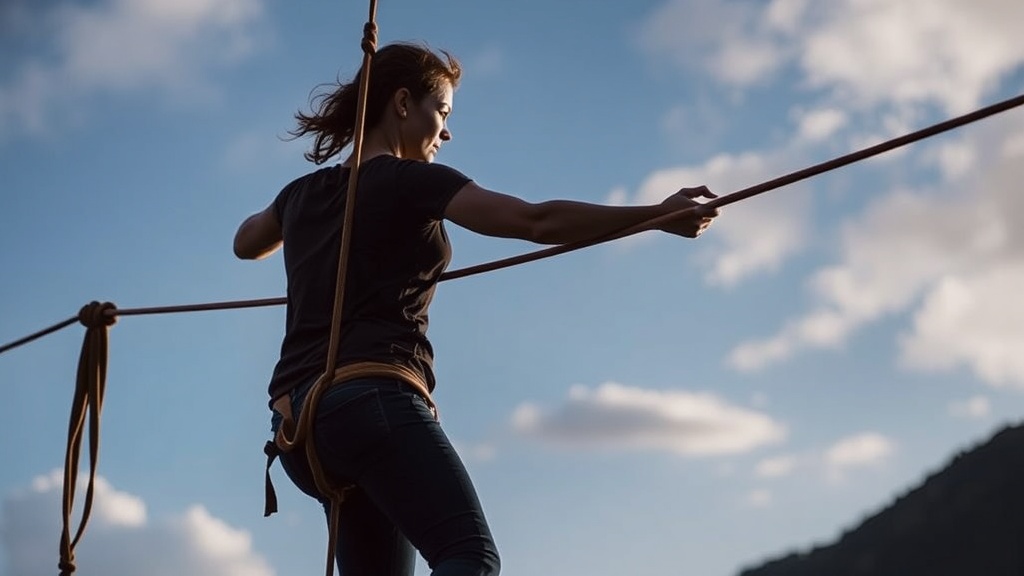
Stabilizing Your Center: A Deep Dive into Slackline Tension

Most people assume that staying on a slackline is purely a matter of foot positioning or staring at a fixed point. They think balance is a static state you achieve by being still. That's a mistake. Balance is actually a dynamic reaction to constant, micro-adjustments. If you're waiting for the line to stop moving before you react, you've already lost. This post covers how to manage your center of gravity and manage the tension within your own body to stay upright during high-intensity sessions.
To stay on the line, you have to understand that your body is a series of interconnected levers. When the line dips or oscillates, your hips, spine, and shoulders must respond in a coordinated rhythm. If your upper body is rigid while your legs are loose—or vice versa—you'll experience a disconnect that leads to a quick fall. We're looking at how to integrate your muscular tension so your movements feel fluid rather than jerky.
Can I improve my balance by tightening my core?
It’s a common trap to think that bracing your core as hard as possible will keep you stable. In reality, excessive tension is the enemy of balance. If you brace too hard, you lose the ability to make the small, subtle corrections required when the line shifts. Think of your core as a shock absorber, not a brick wall. You need enough stability to hold your frame together, but enough flexibility to absorb the vibrations of the webbing.
When you over-brace, you actually become top-heavy. A stiff torso prevents your limbs from acting as counterweights. Instead, aim for a "controlled tension." This means your deep stabilizers (the muscles around your spine and pelvis) are active, but your superficial muscles (like your abs or chest) aren't locked in a rigid grip. This allows you to move with the line rather than fighting against it. If you find yourself gasping for air or feeling breathless while walking, you're likely over-bracing.
How does tension affect my reaction time?
The speed at which you can correct a wobble depends heavily on how much tension you are holding in your limbs. If your legs are completely stiff, you'll react to a movement too late. If they are too loose, you'll overcorrect and create a feedback loop of wobbles. The sweet spot is found in the transition between movement and stillness. This is where proprioception—your body's ability to sense its position in space—really shines.
High-performance slacklining requires a nuanced understanding of muscle engagement. For example, when a heavy vibration hits the line, a relaxed ankle can absorb that energy, whereas a rigid ankle will transmit that shake directly up to your hips and throw you off. You can learn more about the mechanics of human movement through resources like the Physiopedia database, which explains how joint stability and movement patterns work together. Learning to modulate your tension is what separates a beginner from someone who can walk a line with confidence.
The Relationship Between Tension and Gravity
Gravity is always pulling at you, but how much it affects you depends on your center of mass. If your center of mass stays directly over the line, you feel relatively stable. As soon as your weight shifts—even by a few centimeters—the use of the line works against you. To combat this, you must learn to use your arms as dynamic counterweights. Instead of holding them out like static poles, treat them like pendulums that can swing to offset a tilt.
<Consider the following table to help you identify your current tension style:
| Tension Type | Effect on Balance | Resulting Outcome |
|---|---|---|
| Rigid/Static | Prevents micro-adjustments | Frequent falls during high oscillation |
| Loose/Reactive | Too much movement | Overcorrection and wobbling |
| Dynamic/Integrated | Absorbs and adapts | Consistent, fluid movement |
A well-tuned athlete knows how to move through different planes of motion without losing their center. This isn't just about strength; it's about the efficiency of your nervous system. If your brain is constantly screaming at your muscles to tighten up, you'll fatigue much faster. To keep your sessions long and productive, you need to practice "soft" movements. This means keeping your joints slightly unlocked and your movements intentional.
Is there a link between fatigue and balance loss?
Yes, and it's often a neurological issue rather than just muscular strength. As you fatigue, your ability to sense your position in space diminishes. This is why you might feel great for the first twenty minutes, but suddenly find yourself unable to stay on the line after a certain point. This is often a sign that your nervous system is struggling to process the rapid-fire data coming from your feet and ankles. To mitigate this, you should incorporate varied training to build neurological endurance.
One way to build this is through varied surface training. While the slackline is your primary tool, practicing balance on uneven ground or Bosu balls can help refine your proprioceptive feedback loops. For more detailed information on physical conditioning and neurological health, the Strength Level community offers great insights into how different types of training impact overall performance. By building a more responsive nervous system, you'll find that your "window" of stability stays open much longer during a session.
Don't forget that your breath plays a massive role here. Shallow, rapid breathing often accompanies high tension. If you find yourself holding your breath to stay stable, you are sabotating your ability to stay on the line. Deep, rhythmic breathing helps regulate your nervous system, keeping you in a state of focused calm rather than panic. This prevents the "fight or flight" response that often leads to jerky, uncoordinated movements when the line gets difficult.