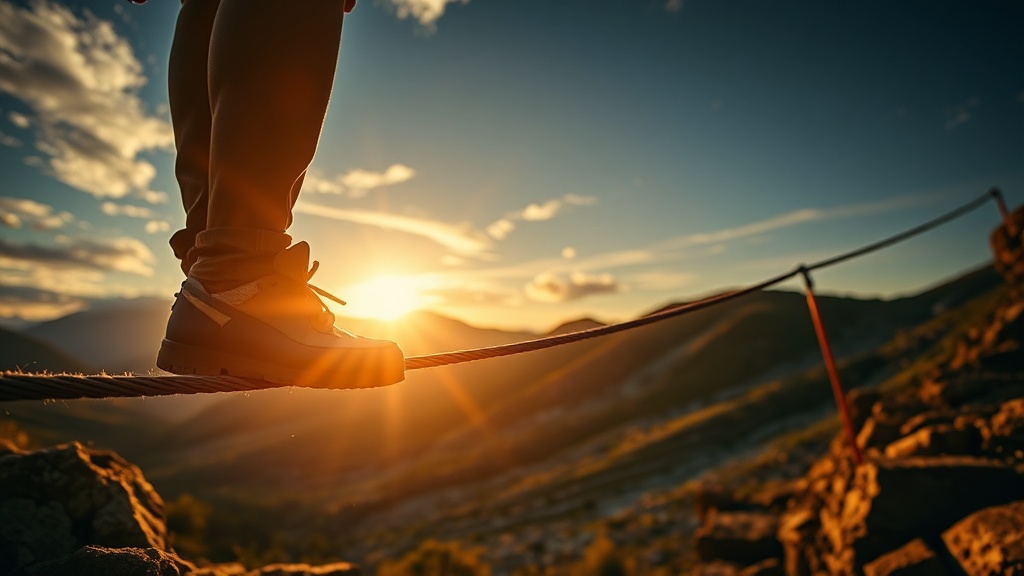
Foot Pressure Secrets for Slackline Stability

This post breaks down exactly where your weight should sit on your feet when slacklining — and why most people get it wrong. You will learn the biomechanics of foot pressure distribution, how ankle mobility limits your control, and specific drills to retrain your stance for longer, more confident walks.
Why does my foot placement feel unstable on a slackline?
The wobble you feel often starts before you even take your first step. Most beginners place their foot on the line like they are stepping onto a curb — heel down first, weight following behind. On a slackline, that approach collapses your balance within milliseconds.
Slacklines are dynamic surfaces. A typical 2-inch line under tension behaves like a narrow trampoline, responding to every shift in pressure. When your weight lands on the heel, the line reacts by bouncing backward — throwing your center of gravity behind your base of support. Your body compensates by flailing your arms, overcorrecting with your hips, or stepping off entirely.
The fix is not about gripping harder or tensing your calves. It is about where you initiate contact. Experienced slackliners land on the midfoot — specifically the ball of the foot just behind the toes — and immediately spread pressure across the entire foot surface. This distributes your weight over the line's center rather than cantilevering it off one edge.
Research from sports biomechanics supports this approach. A study on balance training published in the Journal of Sports Science & Medicine found that midfoot striking during unstable surface training significantly improved proprioceptive control compared to heel-first patterns. Your feet contain thousands of mechanoreceptors — sensory nerves that detect pressure and texture. Landing midfoot activates more of these receptors faster, giving your nervous system better data to make micro-adjustments.
What is the ideal foot position for slackline walking?
The "ideal" position depends on line width and tension, but certain principles apply across setups. For standard 2-inch slacklines (often called "tricklines" or "yogalines"), you want your foot angled slightly outward — roughly 10 to 15 degrees from parallel with the line.
This external rotation does two things. First, it widens your base of support by engaging your hip external rotators (the piriformis and gemelli muscles). Second, it aligns your ankle joint to absorb lateral oscillations more effectively. Think of it like standing on a rolling ship — you do not face the waves head-on; you angle your stance to roll with them.
Pressure distribution matters more than foot angle. Imagine your foot divided into three zones: the forefoot (ball and toes), the midfoot (arch), and the heel. On a slackline, you want roughly 60% of your weight through the forefoot, 30% through the midfoot, and only 10% through the heel. That 10% heel contact is still important — it acts like a keel on a sailboat, providing directional stability — but it should not bear your primary weight.
Your toes play a critical role too. They are not just passive appendages gripping the line; they are active stabilizers. When you press gently downward through your big toe and spread your other toes, you create a claw mechanism that adds friction and fine-tuned control. This is why barefoot slacklining offers better feedback than shoes — you lose that toe dexterity in footwear, even minimalist models.
How does ankle mobility affect slackline balance?
Tight ankles are silent slackline killers. Limited dorsiflexion — the ability to pull your toes toward your shin — forces your body to compensate by leaning forward or bending at the waist. Both movements throw off your center of gravity and make corrections harder.
Test your ankle mobility right now. Kneel facing a wall with your toes about four inches from the baseboard. Try to touch your knee to the wall without your heel lifting. If you cannot do it, your dorsiflexion is restricted — and that restriction is limiting your slackline potential.
The connection is mechanical. When the line wobbles forward, you need to shift your weight back by dorsiflexing at the ankle. If your ankle range is limited, you cannot make that adjustment without breaking at the hips or taking a step. Your body chooses the compensation that keeps you upright — stepping off — rather than the subtle ankle adjustment that keeps you on.
Improving ankle mobility for slacklining requires targeted work. Standard calf stretches help, but you need loaded dorsiflexion — mobility under tension. Try this: stand on a step with your heels hanging off the edge. Lower your heels below the step level while keeping your knees straight, then bend your knees to sink deeper. Hold the deepest position for 30 seconds, rest, and repeat. Do this daily for two weeks and you will notice your feet feel "stickier" on the line — less hunting for position, more grounded confidence.
Drills to retrain your foot mechanics
Knowledge without practice changes nothing. Here are three drills to reprogram your foot pressure patterns:
Static Line Stands: Set up your slackline at knee height. Step onto it with your dominant foot and simply stand. Do not walk. Focus entirely on feeling where your weight sits — scan your foot from heel to toe and adjust until you find that 60/30/10 distribution. Hold for 30 seconds, then switch feet. Do five sets per side. This builds proprioceptive awareness without the complexity of movement.
Toe-Heel Waves: Walk a short 10-foot section of line, but exaggerate your pressure shifts. Step forward and press deliberately through your forefoot, hold two seconds, then shift back to your heel. Repeat this rocking motion with each step. It feels awkward — that is the point. You are teaching your nervous system the full range of pressure control available to you. After a few passes, walk normally and notice how your feet automatically find better positions.
Single-Leg Line Taps: Stand on one foot on the slackline. Lift your other foot and gently tap the line in front of you, then behind you, then to the side. Each tap forces your standing foot to adjust pressure dynamically to maintain balance. This drill ingrains the micro-adjustments that separate beginners from competent slackliners.
Reading feedback from your feet
Your feet tell you everything about your slackline session if you learn to listen. Burning calves usually mean you are gripping the line with your toes instead of distributing pressure. Arch pain suggests you are collapsing inward — try rotating your feet slightly outward. Knee discomfort often traces back to limited ankle mobility forcing compensatory movement upstream.
Warm up your feet before you step on the line. Roll a tennis ball under each foot for 60 seconds — it wakes up those mechanoreceptors we talked about. Do ankle circles and calf raises. Cold, stiff feet give your brain poor information, and poor information leads to poor balance.
The line is a teacher. Every wobble is feedback. Every fall is data. When you shift your focus from "staying on" to "feeling the pressure," progress accelerates. You stop fighting the line and start working with it — adjusting, responding, flowing.
Start your next session with five minutes of deliberate foot focus. Do not worry about walking the full line. Worry about where your weight lives on your standing foot. Get that right, and the walking takes care of itself.