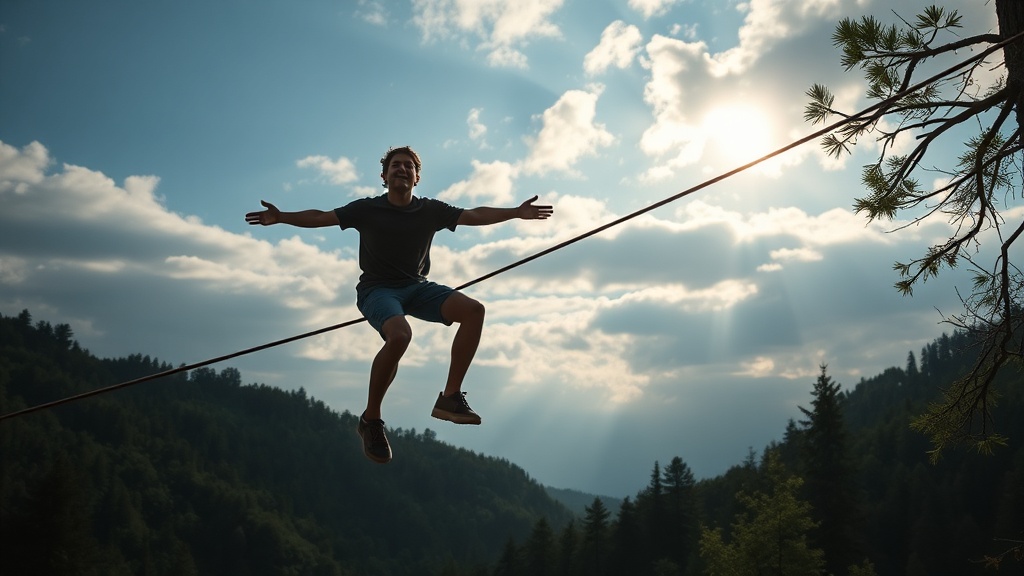
5 key Slackline Skills Every Beginner Must Master First

The Static Balance Hold
Controlled Mounting Technique
Weight Distribution and Hip Alignment
Arm Positioning for Stability
Controlled Dismounts and Recovery
Learning to slackline isn't about walking across a wobbly strap—it's about building a foundation of balance, body awareness, and mental focus that transfers to every physical pursuit. This post breaks down the five core skills every beginner needs to master before progressing to longer lines, tricklines, or highlining. These fundamentals will save hours of frustration, prevent common injuries, and accelerate progress faster than randomly stepping onto a line and hoping for the best.
What's the First Skill Every Slackliner Should Learn?
The first skill isn't walking at all—it's standing. Static balance on two feet forms the bedrock of everything that follows. Most beginners want to shuffle across the line immediately. The catch? That's like trying to run before walking.
Start with a one-inch slackline like the Gibbon Classic Line set at knee height. Step on with both feet hip-width apart. Don't move. Just stand. Feel the line sway beneath you. Let your body learn the micro-adjustments required to stay upright.
Here's the thing—your arms aren't just waving around randomly. They're counterweights. Keep them wide, shoulders relaxed, eyes fixed on a stationary point at eye level (not looking down at your feet). Breathe slowly. Count to ten. Then step off and repeat.
Most beginners bail after three seconds. Fight the urge. Aim for thirty-second holds before even thinking about movement. This static stance trains your vestibular system—the inner ear mechanism controlling balance—in ways that translate directly to surfing, climbing, and skiing.
How Do You Mount a Slackline Without Falling Immediately?
The mount—the way you step onto the line—determines whether your session starts with control or chaos. A sloppy mount wastes energy, destabilizes the line, and trains bad habits.
There are two beginner-friendly mounts:
- The Chongo Mount: Start with one foot on the line (perpendicular), hands on the line for support, then bring the second foot up parallel to the first. This offers maximum stability.
- The Sideways Mount: Stand beside the line, step one foot on perpendicular, then swing the second foot up and turn your hips to face forward. Faster once mastered.
The Chongo dominates early practice—and for good reason. It provides three points of contact (two hands, one foot) before committing fully. When using this mount, keep these points in mind:
- Place the mounting foot dead center of the line width
- Press firmly through the big toe mound—weak foot engagement causes immediate wobble
- Keep the knee slightly bent, never locked
- Look forward, not down at your feet
Worth noting: the line will oscillate when you mount. That's physics, not failure. Wait for the bounce to settle before attempting to stand. Patience here prevents the dreaded "immediate fall" cycle that discourages so many newcomers.
Practice mounting from both sides. Most people favor their dominant leg—slacklining demands ambidextrous competence.
What's the Proper Technique for Taking Those First Steps?
Once static balance feels manageable (thirty-second holds consistently), movement becomes possible. But walking a slackline isn't normal walking. Normal gait relies on momentum and a locked knee at heel strike—both balance killers on webbing.
Slackline walking uses a low, controlled shuffle. Feet stay parallel, never turning perpendicular (that destabilizes everything). Steps stay short—barely six inches apart initially. The knee remains soft, absorbing the line's movement like a shock absorber.
Here's where most beginners go wrong: they look at their feet. The eyes command the vestibular system—where the gaze goes, balance follows. Fix your eyes on a tree, building, or horizon point. Trust your peripheral vision to handle foot placement.
Arm position matters enormously. Extended sideways—like airplane wings—provides rotational stability. Too low and you can't counter big sways. Too high and you lose fine control. Find the sweet spot around shoulder height.
The step itself should roll from heel to toe, distributing weight gradually. Slapping the foot down creates line oscillation. Quiet feet, quiet line. Some practitioners recommend visualizing stepping onto eggshells—deliberate, gentle, controlled.
Why Does Falling Technique Matter More Than Walking?
Everyone falls. Everyone. The question isn't whether you'll fall—it's how. Proper falling technique prevents injuries that end slacklining careers before they begin.
Most slackline injuries happen during uncontrolled dismounts: sprained ankles, bruised heels, knee hyperextensions. Learning to fall correctly transforms a potential injury into a clean reset.
| Bad Falling Habit | Better Alternative | Why It Helps |
|---|---|---|
| Jumping backward off the line | Stepping forward intentionally | Prevents uncontrolled landings and heel bruises |
| Rigid legs on landing | Bent knees absorbing impact | Protects joints and allows roll-out if needed |
| Looking down at feet while falling | Spotting the landing zone | Improves body positioning and spatial awareness |
| Flailing arms wildly | Tucking and rolling (on grass/sand) | Dissipates momentum safely |
Practice intentional dismounts. When balance departs (and it will), make a conscious choice: step forward onto solid ground or commit fully to a controlled jump. The dangerous middle zone—half-committing, hesitating, fighting gravity—that's where ankles roll.
Highliners (those walking lines hundreds of feet up) obsess over falling technique because the stakes demand it. Beginners on one-foot lines should adopt the same respect. The ground isn't forgiving—especially concrete or packed dirt.
Pro tip: set up over grass or sand while learning. The Slackline.com community consistently recommends soft landing surfaces for the first twenty sessions minimum.
How Do Breathing and Mental Focus Affect Slackline Performance?
The physical skills matter—but they're secondary to mental state. Slacklining exposes every anxious thought, every distraction, every moment of impatience. The line becomes a mirror for mental noise.
Watch beginners hold their breath. Tension creeps into shoulders. The jaw clenches. Balance evaporates immediately—because rigid bodies can't make the micro-adjustments slacklining demands.
Proper breathing follows a pattern: nasal inhale for four counts, slow exhale for six. This activates the parasympathetic nervous system (the "rest and digest" state) and quiets the panic response that accompanies wobbles.
More experienced practitioners sometimes use box breathing—inhale four, hold four, exhale four, hold four—especially before challenging moves. The specific pattern matters less than consistency and conscious attention.
Mental focus requires a narrow attention window. Not thinking about work. Not planning dinner. Just the line, the breath, the present step. Some call this a moving meditation—and research backs that up. A 2018 study published in Frontiers in Psychology found slacklining improved postural control and attentional focus in ways distinct from conventional balance training.
Here's the thing—progress isn't linear. Some days the line feels solid as pavement. Other days, five seconds feels impossible. The difference usually isn't physical condition. It's mental state, sleep quality, external stress. Accepting this variability prevents the frustration that drives people to quit.
Putting It All Together: A Beginner's Practice Structure
A productive thirty-minute session might look like this:
- Warm-up (5 minutes): Dynamic stretching focusing on ankles, hips, and shoulders. Jumping jacks or light jogging to improve heart rate.
- Static balance drills (10 minutes): Ten mounts, each held for target duration (start at 10 seconds, progress to 30). Both sides. No walking.
- Controlled walking (10 minutes): Five steps out, turn, five steps back. Focus on quiet feet, soft knees, forward gaze.
- Intentional dismounts (5 minutes): Practice falling well. Step forward deliberately. Absorb impact with bent knees.
Equipment recommendations vary by budget and goals. For backyard practice, the Gibbon Classic Line ($80-100) offers durability and beginner-friendly width. Those wanting progression room might consider the Balance Community primitive setup—more versatile, though trickier to rig initially.
"The line doesn't care about your excuses. It only responds to the pressure you apply and the balance you bring. That's the beauty of it—pure, immediate feedback without judgment."
Master these five skills—static balance, clean mounts, controlled steps, safe falling, and present-moment focus—and the slackline transforms from frustrating novelty to lifelong practice. Every advanced trick, every highline walk, every longline crossing builds on this foundation. Skip the basics and progress stalls. Embrace them, and the line opens up endless possibilities.